The extract constructs many key differences between the regions North and South, as the title of the series is so called, by showing us the stark different living conditions through the 3 different scenes. The first scene consisting of what can be presumed to be a husband and wife arguing over why the husband had to leave his job and how this can not go on. During this argument a clear distinction is shown between the genders via the wife's way of arguing, during the entire scene she only once raised her eyes to the husbands which was at the very climax Where before she is shown as a smaller and weaker character via the camera first using a point of view shot and then showing a medium shot of the characters enforcing the height differences. Furthermore rather than continuing the argument once she has voiced her opinion she slowly backs away into the shadows of the houses hallway, connoting the end of the argument, her feelings on the subject being dark and of course their households fall from the light of the south to the gritty and darkness of the north. Her comment within the argument on the nature of the northern people also shows her feelings, “Its all money and smoke! That's what they eat and breath!”, displaying an earthy bunch akin to her more upperclass opinion of one self.
The young women, who appears to be the daughter of the 2 previous characters is then shown as walking around in what appears to be a common northern industrial town. This is a stark difference between the well furnished house with paintings and rugs to the dark, gloomy, baby crying, dog barking filled alleyway on which the young women is walking. The difference of the area is then also shown by the overlay of the young women reading what we presume to be a letter she is sending to a friend claiming that the area is lovely and green with friendly faces to help you on your way which is totally different to the reality. Although this reading of the letter shows that the young women is literate so she can read and write, which further enforces the richness image of the south compared to the north. Before carrying on into the next scene we then have the young women walking into a tunnel with a bright light at the end shining down into the darkness of the alleyway, as though her journey is leading her to a brighter place even if she is now currently in the dark.
The final scene consists of a non-diagetic whistle noise as the young women is walking down some steps and we then have a vision of a horde of factory workers rushing down the steps as though they were a herd of wild animals rushing for food with no care in the world, this image is shown by the high angle shot of the factory workers feet and legs in numerous numbers above the young women's head. Furthermore a clear difference is shown from her and them via their manner of talking. Clothing as well as the men and women bustling and pushing like equals akin to the young women's mother and father argument in the previous scene.
The stereotypical image of the north is then shown here via their rough attitude towards the young women by how they poke fun and only apologise in an after thought manner. It is also shown by the playful thievery of her personal belongings and the fun the male factory worker has taunting the young women of her money. However this stereotype is then reversed via a 2nd male factory worker who scares off the first and gives back the young women's belonging and then even goes as far to lead her safely to a carriage. Again the man goes against the northern stereotype of being desperate for money by turning down the money they young lady offers him and just tells her to head on her way. This all leads to an overhead shot as though the young women was flying away from the trouble with a final shot in the scene with the male factory worker looking large and incharge following the carriage disappear with his eyes.
To conclude the extract is split up to show a clear distinction between the North and the South with the south being rich having paintings, rugs and expensive clothing akin to the North having poor condition clothing, working in a factory and being displayed primary in dark gloomy alleyways and as a mob. However the final clear differences between the 2 is how the Southerners are upset with the lot and in the young women's case feel she has to lie about her surroundings where as the Northerners seem content and happy with their life.
Sunday, 19 April 2009

Thursday, 2 April 2009
How does Bleak House build up tension and mystery in the extract?
[ -- Draft -- ]
Bleak House builds up mystery in a number of ways, a key method is using blurred objects under or around the characters adding the effect depth of field thereby making the audience feel like they are spying into an event they shouldn't be.
The depth of field is further used throughout the sequence enabling the viewer to see who the action is centred around such as the conversation between the lady and the lawyer enabling the audience to see vivid detail of their expressions.
Tension is built up throughout the first minute or so by the ladies bluntness to cut to the chase, portraying nervousness as well as fear, which is also shown through shots with the reflecting of the characters on glass as thought there is another layer to the true goings on.
The tension is truly built up when the lady views the dropped letter. Firstly we have the extreme close up of the name "John" along with a non-diagetic screeching noise. This shocks the audience who due to only having quiet music and a little diagetic noise in the background, which all adds to the connation of fear.
Secondly we then have the ladies heartbeat quickly increasing in speed and her nervous questions asking about the writer of the letter yet the lawyer says he does not know. This then creates a sense of a critical happening due to all things mentioned and the increasing fidgety movement of the lady and her escalating heartbeat.
The audience is then shown a point of view shot from the ladies perspective looking at the letter which is displayed with an edited outline being blurred adding the overall affect of being dizzy and confused, with this added to the escalating overlayed heartbeat it all leads top the climax of the lady fainting dramatically onto the floor.
The tension slowly dissolves when the lady is taken out of the room however it quickly rebuilt via the lawyer actions. We first have a zoom in of the lawyer and then an extreme close up of the same name "John" and a sudden close up of the lawyer looking after her with a curious expression as thought he is privy to some information we're not.
To conclude Bleak House builds up tension and mystery through the lady and lawyers actions and reactions to each other.
Bleak House builds up mystery in a number of ways, a key method is using blurred objects under or around the characters adding the effect depth of field thereby making the audience feel like they are spying into an event they shouldn't be.
The depth of field is further used throughout the sequence enabling the viewer to see who the action is centred around such as the conversation between the lady and the lawyer enabling the audience to see vivid detail of their expressions.
Tension is built up throughout the first minute or so by the ladies bluntness to cut to the chase, portraying nervousness as well as fear, which is also shown through shots with the reflecting of the characters on glass as thought there is another layer to the true goings on.
The tension is truly built up when the lady views the dropped letter. Firstly we have the extreme close up of the name "John" along with a non-diagetic screeching noise. This shocks the audience who due to only having quiet music and a little diagetic noise in the background, which all adds to the connation of fear.
Secondly we then have the ladies heartbeat quickly increasing in speed and her nervous questions asking about the writer of the letter yet the lawyer says he does not know. This then creates a sense of a critical happening due to all things mentioned and the increasing fidgety movement of the lady and her escalating heartbeat.
The audience is then shown a point of view shot from the ladies perspective looking at the letter which is displayed with an edited outline being blurred adding the overall affect of being dizzy and confused, with this added to the escalating overlayed heartbeat it all leads top the climax of the lady fainting dramatically onto the floor.
The tension slowly dissolves when the lady is taken out of the room however it quickly rebuilt via the lawyer actions. We first have a zoom in of the lawyer and then an extreme close up of the same name "John" and a sudden close up of the lawyer looking after her with a curious expression as thought he is privy to some information we're not.
To conclude Bleak House builds up tension and mystery through the lady and lawyers actions and reactions to each other.
Tuesday, 31 March 2009
How has new technology influenced production, marketing and exhibition in the film industries in the last 30 years?
Quite simply new technology has blasted apart the media industry and it's way of doing everything in such a way that it's inconceivable to think back. Firstly if we just look at production we can see by looking at films such as StarWars Attack of the Clones, Cloverfield, The DarkKnight and especially in animated films like Wall-E. If we take StarWars II as the prime example of production we can clearly see that without modern day technology it would be impossible for them to produce such a film.
StarWars II Attack of the Clones consisted of some of the most advanced technology of it's time, if we simply look at a few clips we can see the that the huge battle scenes were created by state of the art CGI (computer-generated images) which can take hours to create just a second of it via a huge mass of computers. Furthermore many of the scenes of the character Yoda would not have been possible in the film without technology to create an virtual character, in previous episodes of the StarWars series Yoda was simply a puppet, but that would not work in this film due to some intense action scenes.
If we then look at the Wall-E it is clear without the technology we have today this film would not have come off paper, it would take a huge array of computers days, if not weeks, to compile the entire Wall-E film into one suitably sized median to enable distribution. Without computers and the special type of CGI used only by Pixar we would not see Wall-E as it is today, similar things in the past such as Toy Story, also produced by Pixar, would not be around without the huge amount of computing power at their disposal. It would have taken them literally years to draw out all the animations by hand, and even then they would not have the same quality as which the computers create.
Other noticeable technologies which have appeared over the 30 years affecting production include such things as the Green / Blue wall, enabling actors to become immersed via CGI into an entirely different world, and also allows such films as Cloverfield to display amazing monsters not possible via normal materials. However the main thing that technology has brought to the production table is the ability of having real-sized battles on the screen, 30 years previous films such as StarWars had to rely on a few extras to buff up the large battle scenes where now a 1 man actor can be repeated and create a scene with literally thousands of people on at once without a hitch.
Technology also had a huge impact on the marketing of films due to the internet being officially born as we know it today in 1991. 2 prime examples of the difference in marketing is The DarkKnight and Cloverfield. The DarkKnight itself had a huge 'propaganda' before it was even close to being released with a massive amount of clues and tricks laid throughout numerous Batman websites to add interest to the film and only give the littlest amount of information for hours worth of effort. However it proved to be a hit, 1000s of internet users worldwide joined in on the mass Batman hunt to figure out the clues and eventually got a little teaser of the joker. This shows that new technology and the speed at which we can transmit information from one person to another just increases the urge to complete a puzzel.
Likewise due to technology many teasers can now be shown everywhere at once via social networking sits such as youtube and facebook enabling a huge amount of viewers to have a peek before the film is out of production. Cloverfield used this to its advantage with no TV advertising and only a few select cinema ads it relied on the speed that word of mouth now travels and we all watched on in amazement as a film with no major actor or a very good storyline suddenly spread across the internet like wildfire.
Exhibition was also affected via new technologies via the increase in capacity of the transport of their films from VHS to DVD and now to Blu-Ray and the ability to now mass produce everything from posters to bonus material.
To conclude it is clear that new technology has had a huge impact on everything across the media industry, and it's still changing with the rate of technological advance being on average having the raw power of processing doubling every 2 years.
StarWars II Attack of the Clones consisted of some of the most advanced technology of it's time, if we simply look at a few clips we can see the that the huge battle scenes were created by state of the art CGI (computer-generated images) which can take hours to create just a second of it via a huge mass of computers. Furthermore many of the scenes of the character Yoda would not have been possible in the film without technology to create an virtual character, in previous episodes of the StarWars series Yoda was simply a puppet, but that would not work in this film due to some intense action scenes.
If we then look at the Wall-E it is clear without the technology we have today this film would not have come off paper, it would take a huge array of computers days, if not weeks, to compile the entire Wall-E film into one suitably sized median to enable distribution. Without computers and the special type of CGI used only by Pixar we would not see Wall-E as it is today, similar things in the past such as Toy Story, also produced by Pixar, would not be around without the huge amount of computing power at their disposal. It would have taken them literally years to draw out all the animations by hand, and even then they would not have the same quality as which the computers create.
Other noticeable technologies which have appeared over the 30 years affecting production include such things as the Green / Blue wall, enabling actors to become immersed via CGI into an entirely different world, and also allows such films as Cloverfield to display amazing monsters not possible via normal materials. However the main thing that technology has brought to the production table is the ability of having real-sized battles on the screen, 30 years previous films such as StarWars had to rely on a few extras to buff up the large battle scenes where now a 1 man actor can be repeated and create a scene with literally thousands of people on at once without a hitch.
Technology also had a huge impact on the marketing of films due to the internet being officially born as we know it today in 1991. 2 prime examples of the difference in marketing is The DarkKnight and Cloverfield. The DarkKnight itself had a huge 'propaganda' before it was even close to being released with a massive amount of clues and tricks laid throughout numerous Batman websites to add interest to the film and only give the littlest amount of information for hours worth of effort. However it proved to be a hit, 1000s of internet users worldwide joined in on the mass Batman hunt to figure out the clues and eventually got a little teaser of the joker. This shows that new technology and the speed at which we can transmit information from one person to another just increases the urge to complete a puzzel.
Likewise due to technology many teasers can now be shown everywhere at once via social networking sits such as youtube and facebook enabling a huge amount of viewers to have a peek before the film is out of production. Cloverfield used this to its advantage with no TV advertising and only a few select cinema ads it relied on the speed that word of mouth now travels and we all watched on in amazement as a film with no major actor or a very good storyline suddenly spread across the internet like wildfire.
Exhibition was also affected via new technologies via the increase in capacity of the transport of their films from VHS to DVD and now to Blu-Ray and the ability to now mass produce everything from posters to bonus material.
To conclude it is clear that new technology has had a huge impact on everything across the media industry, and it's still changing with the rate of technological advance being on average having the raw power of processing doubling every 2 years.
Sunday, 29 March 2009
Snatched Evaluation
Evaluation of 'Snatched'. In what ways does your media product use, develop or challenge forms and conventions of real media products?
My group thriller “Snatched” was primarily inspired by 4 films, Psycho (Alfred Hitchcock 1960), The Third Man (Carol Reed 1949), This is England (Shane Meadows 2006) and Witness (Peter Weir 1985). The mise-en-scene displayed via The Third Man with it's post-war Vienna setting provides the audience with a gritty and dark atmosphere as well as adding a level of tension to the shots, likewise This is England, even though not a thriller, employs a similar approach with a poor urban setting adding the same feeling as The Third Man while also adding a level of realism to the film. This provides a connection to the audience allowing them to relate to the characters involved via it's location. For this reason we decided to take on the convention and decided to have our location as a run-down car park, thereby bringing across the unglamorous location and the vulnerable feeling of our female victim Grace.
The image above is showing a scene from Snatched where grace, the female victim, has been shut into the boot of Tom's car. This is developing the convention of vulnerability displayed by many thriller films via claustrophobic space, our prime inspiration for this scene was via the film Witness. We realised that by employing a point of view shot rather than having an array of shots similar to Witness on the small Amish boy we'd allow a larger connection to the situation Grace was in. Then by adding in cross-fade affects we also showed the damaging affects of the drugs on Grace and her ability to act.

Furthermore we decided to follow the similar line of The Third Man again with it's large range of tilt shots, close ups and medium shots to provide a general feeling of unease and tension throughout our opening scene, likewise we tried to follow a similar lighting scheme via the gloomy surrounding area.
How does your media product represent particular social groups?
Our thriller production represents primarily two contradicting pictures of a female character, from the unsuspecting victim Grace to the calculating villain Mary. We present Grace as the traditional representation of a female character, which is vulnerable to the events unfolding before them, as seen in Psycho via Marion Crane. Where as Mary is shown as a calculating villain, not necessarily a strong woman but someone who looks out for themselves, this challenges the traditional representation through and through, and provides a nice counter balance to the other extreme.
The other character shown in the opening Tom, is displayed as a the stereotypical male villain, the one in control with all the cards in his hand via having better standard of clothing to having the car which Mary relies on. This is also a traditional representation of a male character as shown through Psycho via such characters as Sam Loomis.
What kind of media institution might distribute your media product and why?
I would think that Snatched would most likely be distributed by ourselves than a company, at least to begin with, due to it being created by complete unknowns within the industry, while also being in competition with 1000s of other films created in the same means all over the country. Plus due to high costs of distribution we would most likely ignore trying to get it shown within a Multiplex cinema or even an Art House, we'd use modern day technologies instead.
Like many other films we would have to rely on word of mouth to get us off the floor, to do this we would distribute the film via social networking sites as well as streaming sites such as Youtube, Bebo, Facebook and other vacillates thereby hoping to attract the attention of a real company via the amount of audience viewings. So by putting it online we would enable 1000s to view our movie quickly and easily while also having practically no cost to distribute it at all while also providing the means of spreading it via the word of mouth by easily providing the ability to put the film onto such devices as an Ipod, Nintendo DS or even your phone via different encoding.

If we were successful in gaining a large following / fan base we could then approach a small distribution company such as Warp Films and provide evidence of an interested audience as well as showing many links to their own supported film This is England which was a huge success and argue Snatched could be as well if given the chance. However due to already being available on the internet for free we would most likely ignore DVD and try to have a TV airing instead thereby earning money via advertising.
Who would be the audience for your media product?
The primary audience for Snatched is the demographic 18-25 who enjoy off beat thrillers because female audiences will be attracted to the 2 extreme pictures of the female personality displayed via Grace and Mary, one vulnerable and weak while the other in control. Likewise the male audience would be attracted to Tom's stake in the goings on of the film and whether he was truly in control or he was actually doing the wishes of Mary.
I would expect the social class to be around the middle class such as the demographic C1 and C2 due to Snatched not being a overly complex film yet also not being as easy to understand as a stop sign which provides intrigue to the audience. This would provide both the University educated student and the blue collar worker something to think about during the film hooking them to watch it to the end to find out what happens.
How did you attract/address your audience?
The audience have been attracted to our film via it's intriguing title 'Snatched' and the concept of a drug addict selling out her friend to a male drug dealer. The audience would also first be attracted due to the film being free and available to watch when ever you want online. This would also hopefully increase the rate of word to mouth promoting the film further attracting a large audience.
Other reasons the audience may be attracted to the film is the location of Norwich, many viewers will watch the film just because it is filmed where the live. Likewise due to having the concept of kidnapping and drug dealing at the front of the film many viewers will be attracted to sit down and see how it plays out for the character Grace.
If we look at the questionnaire we carried out on some year 12 and 13 media students we also found that many of them of the age of 16-18 were attracted to the film due to it's cliffhanger opening and impressive audio with the large impact of the sirens.
What have you learnt about technologies from the process of construction this product?
Throughout this project I have learnt a wide range of skills from understanding how to use the camera and it's varying functions as well as understanding the key importance of using the tripod for a steady affect, otherwise our film would more likely cause motion sickness than entertain the audience. We also learned due to our first attempt at creating a thriller that you must thoroughly plan the camera shots if you wish to provided a variety otherwise you may find yourself with 90% of the shots all being medium thereby lowering the impact of the action onto the audience.
When we edited the project I learnt how to use Adobe Premier Elements, while this program is very basic compared to its big brother Adobe Premier CS4 it does provide some very useful functions such as cross dissolve, dip to black and the ability to export the video into any format we wish. Thanks to the cross dissolve and dip to black we could add more impact to our thriller production, a prime example is when Grace is locked in the boot and has the affect of the drugs in her system, we were able to add in a cross dissolve affect to bring across her vulnerability in that situation by making a blurred affect.
I also learnt that if you wish to keep the audience hooked you must keep the film simple enough to follow but complex enough to keep interesting, otherwise they may grow bored, I feel we did this by employing a simple linear narrative which answers many questions but also leaves many more unanswered.
Finally we learnt during the construction of our product that speed is of an essence, and we found that the school computers were sometimes not up to the task and would operate very slowly compared to our own personal computers, for this reason we learned a great deal of patience and understood when it was our own fault for the program operating slowly or the computer itself being outdated.
Looking back at your preliminary task, what do you feel you have learnt in the progression from it to the full product?
The preliminary task enabled me to understand better how our group would work, I found it very pleasant in the way we all contributed throughout both projects, however we found that planning was key to it all. Without planning all we had was waffle. During our preliminary task we got to know each other a bit better and gauge each others weaknesses and strengths, I found quite clearly that both Lauren and Emily were far better at acting than I was, it especially helped that Lauren is doing a Drama A-level letting her bring a theatrical perspective to the production.
During the preliminary task I found that keeping on the 180degree line rule was key, otherwise you could seriously confuse the audience thereby making the task a waste of time and energy! The shooting the first time round went wrong due to miscommunication, however after putting our heads together and due to Lauren's quick thinking we were able to salvage the small amount of time we had to produce another 15 minutes of good footage.
The responsibilities throughout were well spread out, I stepped down from an acting role in our first production thriller idea and then directed the camera instead on our second idea and took many shot. The acting throughout was done by Emily Mullender and Lauren Jordan, both members of my group, who did it extremely well regardless of having to lie on a freezing cold car park roof.
Throughout editing both tasks we found it the sound a tricky situation due to having a large amount of background noise however by changing the volume settings we were able to turn down the volume enough that the background noise was noticeable but not bothersome yet you could still hear the dialogue or music clearly. We also found that audio played a huge part in bringing across the message of the scene, if you had upbeat it may not look as terrible as you wish it be thereby damaging the overall mise-en-scene.
Overall throughout the entire course I feel we worked well as a group and we handled our blunders and success with equal skill and thought and that the end results were what we wanted. The primarily task ticked all the correct boxes and our thriller production was just that, a thriller.
My group thriller “Snatched” was primarily inspired by 4 films, Psycho (Alfred Hitchcock 1960), The Third Man (Carol Reed 1949), This is England (Shane Meadows 2006) and Witness (Peter Weir 1985). The mise-en-scene displayed via The Third Man with it's post-war Vienna setting provides the audience with a gritty and dark atmosphere as well as adding a level of tension to the shots, likewise This is England, even though not a thriller, employs a similar approach with a poor urban setting adding the same feeling as The Third Man while also adding a level of realism to the film. This provides a connection to the audience allowing them to relate to the characters involved via it's location. For this reason we decided to take on the convention and decided to have our location as a run-down car park, thereby bringing across the unglamorous location and the vulnerable feeling of our female victim Grace.
The image above is showing a scene from Snatched where grace, the female victim, has been shut into the boot of Tom's car. This is developing the convention of vulnerability displayed by many thriller films via claustrophobic space, our prime inspiration for this scene was via the film Witness. We realised that by employing a point of view shot rather than having an array of shots similar to Witness on the small Amish boy we'd allow a larger connection to the situation Grace was in. Then by adding in cross-fade affects we also showed the damaging affects of the drugs on Grace and her ability to act.

Furthermore we decided to follow the similar line of The Third Man again with it's large range of tilt shots, close ups and medium shots to provide a general feeling of unease and tension throughout our opening scene, likewise we tried to follow a similar lighting scheme via the gloomy surrounding area.
How does your media product represent particular social groups?
Our thriller production represents primarily two contradicting pictures of a female character, from the unsuspecting victim Grace to the calculating villain Mary. We present Grace as the traditional representation of a female character, which is vulnerable to the events unfolding before them, as seen in Psycho via Marion Crane. Where as Mary is shown as a calculating villain, not necessarily a strong woman but someone who looks out for themselves, this challenges the traditional representation through and through, and provides a nice counter balance to the other extreme.
The other character shown in the opening Tom, is displayed as a the stereotypical male villain, the one in control with all the cards in his hand via having better standard of clothing to having the car which Mary relies on. This is also a traditional representation of a male character as shown through Psycho via such characters as Sam Loomis.
What kind of media institution might distribute your media product and why?
I would think that Snatched would most likely be distributed by ourselves than a company, at least to begin with, due to it being created by complete unknowns within the industry, while also being in competition with 1000s of other films created in the same means all over the country. Plus due to high costs of distribution we would most likely ignore trying to get it shown within a Multiplex cinema or even an Art House, we'd use modern day technologies instead.
Like many other films we would have to rely on word of mouth to get us off the floor, to do this we would distribute the film via social networking sites as well as streaming sites such as Youtube, Bebo, Facebook and other vacillates thereby hoping to attract the attention of a real company via the amount of audience viewings. So by putting it online we would enable 1000s to view our movie quickly and easily while also having practically no cost to distribute it at all while also providing the means of spreading it via the word of mouth by easily providing the ability to put the film onto such devices as an Ipod, Nintendo DS or even your phone via different encoding.

If we were successful in gaining a large following / fan base we could then approach a small distribution company such as Warp Films and provide evidence of an interested audience as well as showing many links to their own supported film This is England which was a huge success and argue Snatched could be as well if given the chance. However due to already being available on the internet for free we would most likely ignore DVD and try to have a TV airing instead thereby earning money via advertising.
Who would be the audience for your media product?
The primary audience for Snatched is the demographic 18-25 who enjoy off beat thrillers because female audiences will be attracted to the 2 extreme pictures of the female personality displayed via Grace and Mary, one vulnerable and weak while the other in control. Likewise the male audience would be attracted to Tom's stake in the goings on of the film and whether he was truly in control or he was actually doing the wishes of Mary.
I would expect the social class to be around the middle class such as the demographic C1 and C2 due to Snatched not being a overly complex film yet also not being as easy to understand as a stop sign which provides intrigue to the audience. This would provide both the University educated student and the blue collar worker something to think about during the film hooking them to watch it to the end to find out what happens.
How did you attract/address your audience?
The audience have been attracted to our film via it's intriguing title 'Snatched' and the concept of a drug addict selling out her friend to a male drug dealer. The audience would also first be attracted due to the film being free and available to watch when ever you want online. This would also hopefully increase the rate of word to mouth promoting the film further attracting a large audience.
Other reasons the audience may be attracted to the film is the location of Norwich, many viewers will watch the film just because it is filmed where the live. Likewise due to having the concept of kidnapping and drug dealing at the front of the film many viewers will be attracted to sit down and see how it plays out for the character Grace.
If we look at the questionnaire we carried out on some year 12 and 13 media students we also found that many of them of the age of 16-18 were attracted to the film due to it's cliffhanger opening and impressive audio with the large impact of the sirens.
What have you learnt about technologies from the process of construction this product?
Throughout this project I have learnt a wide range of skills from understanding how to use the camera and it's varying functions as well as understanding the key importance of using the tripod for a steady affect, otherwise our film would more likely cause motion sickness than entertain the audience. We also learned due to our first attempt at creating a thriller that you must thoroughly plan the camera shots if you wish to provided a variety otherwise you may find yourself with 90% of the shots all being medium thereby lowering the impact of the action onto the audience.
When we edited the project I learnt how to use Adobe Premier Elements, while this program is very basic compared to its big brother Adobe Premier CS4 it does provide some very useful functions such as cross dissolve, dip to black and the ability to export the video into any format we wish. Thanks to the cross dissolve and dip to black we could add more impact to our thriller production, a prime example is when Grace is locked in the boot and has the affect of the drugs in her system, we were able to add in a cross dissolve affect to bring across her vulnerability in that situation by making a blurred affect.
I also learnt that if you wish to keep the audience hooked you must keep the film simple enough to follow but complex enough to keep interesting, otherwise they may grow bored, I feel we did this by employing a simple linear narrative which answers many questions but also leaves many more unanswered.
Finally we learnt during the construction of our product that speed is of an essence, and we found that the school computers were sometimes not up to the task and would operate very slowly compared to our own personal computers, for this reason we learned a great deal of patience and understood when it was our own fault for the program operating slowly or the computer itself being outdated.
Looking back at your preliminary task, what do you feel you have learnt in the progression from it to the full product?
The preliminary task enabled me to understand better how our group would work, I found it very pleasant in the way we all contributed throughout both projects, however we found that planning was key to it all. Without planning all we had was waffle. During our preliminary task we got to know each other a bit better and gauge each others weaknesses and strengths, I found quite clearly that both Lauren and Emily were far better at acting than I was, it especially helped that Lauren is doing a Drama A-level letting her bring a theatrical perspective to the production.
During the preliminary task I found that keeping on the 180degree line rule was key, otherwise you could seriously confuse the audience thereby making the task a waste of time and energy! The shooting the first time round went wrong due to miscommunication, however after putting our heads together and due to Lauren's quick thinking we were able to salvage the small amount of time we had to produce another 15 minutes of good footage.
The responsibilities throughout were well spread out, I stepped down from an acting role in our first production thriller idea and then directed the camera instead on our second idea and took many shot. The acting throughout was done by Emily Mullender and Lauren Jordan, both members of my group, who did it extremely well regardless of having to lie on a freezing cold car park roof.
Throughout editing both tasks we found it the sound a tricky situation due to having a large amount of background noise however by changing the volume settings we were able to turn down the volume enough that the background noise was noticeable but not bothersome yet you could still hear the dialogue or music clearly. We also found that audio played a huge part in bringing across the message of the scene, if you had upbeat it may not look as terrible as you wish it be thereby damaging the overall mise-en-scene.
Overall throughout the entire course I feel we worked well as a group and we handled our blunders and success with equal skill and thought and that the end results were what we wanted. The primarily task ticked all the correct boxes and our thriller production was just that, a thriller.
Tuesday, 10 March 2009
What is the balance of Realism and drama in soaps?
Many Soaps attempt to create a balance between realism and drama. The former enables the audience to relate to the situation each character is in adding more interest where as the later keeps the audience hooked and actively interested to see what happens next. If this isn't correctly balanced it can cause a large loss of the audience, for instance in East Enders when it goes to the point of unrealistic with characters being buried alive a large portion of the audience could no longer relate and therefore stopped watching or filed a complaint, even though it had a huge amount of drama which undoubtedly did keep some of the audience interested.
Where as on the other end of the spectrum East Enders is realistic by how it's always chronological, you never jump back and forth within an episode. Also it enforces realism by having holidays actually on the day such as a special Christmas episode, valentines on valentines day and not having Christmas during august. Likewise Coronation Street follows a similar pattern keeping time correct.
East Enders also has drama in with relationship disputes, fraud, distrust, fights and of course a wedding or death thrown in once a season to keep the drama and suspense thereby keeping the audience hooked enough to sit down the next night and watch it all over again. However coronation street for instance has low drama due to wanting to attract the older audience.
Overall soaps strive to keep a balance between the two because it promises a more main stream audience against a more specific one.
Where as on the other end of the spectrum East Enders is realistic by how it's always chronological, you never jump back and forth within an episode. Also it enforces realism by having holidays actually on the day such as a special Christmas episode, valentines on valentines day and not having Christmas during august. Likewise Coronation Street follows a similar pattern keeping time correct.
East Enders also has drama in with relationship disputes, fraud, distrust, fights and of course a wedding or death thrown in once a season to keep the drama and suspense thereby keeping the audience hooked enough to sit down the next night and watch it all over again. However coronation street for instance has low drama due to wanting to attract the older audience.
Overall soaps strive to keep a balance between the two because it promises a more main stream audience against a more specific one.
Tuesday, 3 March 2009
Research on Institutions & Piracy
Below you will find notes on the Institutions Warp Films, Universal Pictures and Working Titles in a
Warp Film
Simple, due to the increase in technology piracy has become all the easier with it becoming almost a competition to see who can upload a film onto the internet the day it is released, or sometimes even leaking it before it's released. The film industry isn't alone in this problem, many other sectors in the economy is also being affected from books to video games.
Technology behind piracy comes in 2 major forms, being either peer-to-peer downloading via torrents and the like via search engine sites such as "The Pirate Bay" or other faster sites such as rapidshare.com who provide a hosting service.
Interestingly enough uploading copyright material is against the Terms & Conditions on Rapidshare, however they do not take it upon themselves to weed it out but the owners which is pointless since it is free to use.
Overall there is no way to stop piracy, it will only get worse until the media industry and others either design better security or embrace it.
Warp Film
- British Film Company
- Warpfilms was setup in 1999
- Partner with WarpRecords
- Known for releasing low budget but high earners such as This is England.
- This is England is Warps most successful film to date.
- Famous directors such as Shane Meadows.
- An American Film Studio - Does both production and distribution
- Universal Pictures / Studios was officially setup in 1925 however has it roots back to 1909 with the Yankee Film Company.
- Since 2007 Universal Pictures has distributed all of Working Titles productions.
- They own 67% of Working Title.
- Universal Pictures are a mainstream American Company and is the 2nd longest living company
- The found was Carl Laemmie
- Produced British films such as Bridget Jones' Diray, Love Actually and Hot Fuzz.
- Founded in 1984 by Tim Bevan and Sarah Radclyffe.
- It's one of the largest British production companies and is based in London.
- It's primarily owned by Univeral Studies and BBC.
- Also has a baby brand called Working Title 2 which produces low budget films like Shawn of the Dead.
- Produces both Tv programs and Films
Simple, due to the increase in technology piracy has become all the easier with it becoming almost a competition to see who can upload a film onto the internet the day it is released, or sometimes even leaking it before it's released. The film industry isn't alone in this problem, many other sectors in the economy is also being affected from books to video games.
Technology behind piracy comes in 2 major forms, being either peer-to-peer downloading via torrents and the like via search engine sites such as "The Pirate Bay" or other faster sites such as rapidshare.com who provide a hosting service.
Interestingly enough uploading copyright material is against the Terms & Conditions on Rapidshare, however they do not take it upon themselves to weed it out but the owners which is pointless since it is free to use.
Overall there is no way to stop piracy, it will only get worse until the media industry and others either design better security or embrace it.
Monday, 2 March 2009
Representation of Youth in Skins
Note:- This is homework is to do only 1 PARAGRAPH, so only one stereotypical representation will be looked at in detail.
 Skins displays youth via a large number of stereotypes from the bad language, messy surroundings, hectic social lives, enjoyment of annoying their parents as well as constant mentioning of sex throughout the series. However throughout youth are being represented as having a hectic social life from the first episode with Tony calling up numerous friends via his mobile phone and having conversations with over 4 different characters, this representation is further enforced by Tony holding multiple conversations on the mobile at the same which then leads to the audience watching a quick succession of shots switching from him to varying characters. This allows you to name each character and get a small idea, however at the same time with the quick succession of shots and constant switching of conversation from Tony to another character the audience gains a true understanding of how hectic the life of a youth is.
 Skins displays youth via a large number of stereotypes from the bad language, messy surroundings, hectic social lives, enjoyment of annoying their parents as well as constant mentioning of sex throughout the series. However throughout youth are being represented as having a hectic social life from the first episode with Tony calling up numerous friends via his mobile phone and having conversations with over 4 different characters, this representation is further enforced by Tony holding multiple conversations on the mobile at the same which then leads to the audience watching a quick succession of shots switching from him to varying characters. This allows you to name each character and get a small idea, however at the same time with the quick succession of shots and constant switching of conversation from Tony to another character the audience gains a true understanding of how hectic the life of a youth is.
Friday, 20 February 2009
Case Study: Taken
 Thriller: Taken
Director: Pierre Morel
Production Company: Europa Corp
Release Date: 26 September 2008 (UK
Country where made: France
Awards nominated: None
Synopsis
Bryan a retired-CIA agents daughter, aged 17 named Kim, is kidnapped by a Albanian human trafficking gang while on holiday in Paris. It then entails a chase to save his daughter before time runs out.
As you can see, the synopsis is a common "Bourne" like title and display the cliche action through with Bryan becoming near super-human by the end of the film. However the grittiness of the location and base of the story line involving human trafficking pulls the film into the Thriller genre.
Opening Scenes
The open scene uses a flash back affect with a transition of jittery movement and a halo affect of lighting around the edges providing a feel of looking into the blurred past. We have a few close ups of Kim as a child, as though Bryan who we see briefly when we come back to the present is smiling to himself about, this then leads onto Bryan going out to a shop, which we presume, is for him to buy a present.
After collecting the present we have an almost obsessive parent wrapping up the present with absolute precision. The audience is then allowed to guess that we've moved into the future where Bryan is now getting out of a car in front of a large mansion where a party is taking place. After a brief spat with his Ex-wife Lenore he finally is allowed to give his present to his overly loving daughter Kim. Kim is displayed as an average young girl easily impressed and filled with love, practically leaping to give Bryan a hug.
However after giving her the present and a few moments of love the rich Step-Dad Stuart then comes out leading alone a horse, Kim then totally ignores her real father and screams a girlish little noise and sprints to the horse shouting "I love you I love you" over and over while hugging the horse.
The camera then pulls a 180 degree turn to Bryan, who we see standing while switching to an over the shoulder shot and back again until we see him look down at his own gift lying ignored next to his feet which moments before his daughter was loving. After this shot the audience is imprinted with the emotion of feeling sorry for Bryan, someone who obviously loves his daughter but is totally out down by his replacement, Stuart.
Representation of Gender
Throughout the film females were represented as weak and vulnerable to the events at hand whether at home in perfect safety such as Lenore or the unfortunate girls within the human trafficking market. This is further enforced by all the of the villains being male and Bryan being the only character throughout the film fighting to save his daughter even though Lenore and Stuart had the money to burn.
This is traditional representation which you would expect from most films displayed in other titles such as The Third Man, Psycho etc.
Wednesday, 18 February 2009
Thriller Opening Youtube Video
This is our finished project, just to provide a quick peep.
Enjoy! Evaluation coming soon.
Enjoy! Evaluation coming soon.
Thriller Opening Planning
In this post you will find all of the Thriller initial Planning and ideas ranging from Location to Costume. Please note due to the shear amount of information and the lack of being able to correctly display it will make it appear in a slight mess..
Brief Synopsis of plot
Shots Outlined
Characters
Victims
Villains
Extras
Casting
Location
Sound
Props / Objects
Equipment List
The plot entails 2 female characters exchanging a pill, which the audience presumes is a drug, and thereby having the female victim take the drug and being kidnapped and put into a boot of a car. This is then followed with a speedy drive away.
Shots Outlined
You will notice there are more here than on the storyboards, this is to provide more detailed information on how we plan to do the shots due to my lack of ability of drawing anything better than a stick men.
Opening Scene consisting of a blurred long shot of 2 female characters.
Followed with a zooming in shot of the two characters.
We then have a close up of the characters exchanging the drug itself.
We then have a close up of the female victim before she takes the drug, as though thinking about it.
The female victim then takes the drug, and we have a quick following of close ups / extreme closes up along with some fade to black transitions to add to the confusion.
We then have a slow motion of the victim slowly falling to the ground.
This follows with an extreme close up of the other female character crying out for help from her male associate
A quick switch shot to the male character open the boot of his car and walking over to help pick up the victim
We then track the characters carrying the victim and putting her into the boot of the car. All the while with the same music track playing.
We suddenly switch to the victims point of view with her in the car boot looking around in a confused state, this includes some heavy breathing via diagetic sound.
The villains are then shown to be having a conversation before separating to either side of the screen.
The male villain is then shown getting in the car and slamming the door shut.
This then follows with some clever camera work using the car rear view mirror showing the two villains looking at each other.
After shaking his head in disgust the male villain then drives starts to drive away after having an outside of the car shot via a tilt to add to the feeling of confusion.
The car is then tracked and zoomed in upon to get a better view of the license plate along.
Finally the car turns around a corner and we can no longer follow it allowing us to fade to black leaving the audience with the question in their head asking "What happened to Grace?"
Characters
Within the Thriller Opening there are 3 characters, 2 villains and a single victim. The opening is dominated by the 2 female characters and half way through we then see the only male character, also a villain.
Victims
Grace – Leading Female Role – 17 years old – Clothes are a grey hoodie, white trainers and genes
Grace is displayed as a rather unaware girl, not expecting to be kidnapped since she freely takes the drug infront of the other female character. As thought she may be a friend, someone to be trusted.
Villains
Tom – 28 years old – Clothes are a thick coat with linen trousers, dark shoes, displaying money.
Mary – 17 years old – Clothes are the same as Grace's, grey hoodie and genes with trainers.
Casting
Grace – Emily Mullenderr
Tom – Andy Drane
Mary – Lauren Jordan
LocationWe have decided to set the thriller opening in a out of the way car park within Norwich during the early hours of a winter evening. This provides the thriller generics such as unglamorous, remote and threatening location mainly influenced by the thriller 'This is England' by Shane Meadows and the gritting feeling it inspires.
The majority of the sound within the opening scene will consist of a unsigned / uncopyrighted music track called the "Nu Piano Project"
However we also use diagetic sound of Grace's heavy breathing to add to the feeling of entrapment.
Props / Objects
The props include the Car as well as some harmless pills to look like drugs.
Equipment List
Camera, Camera Stand etc. Nothing else was used.
Title
In the end after discussing as a group we settled with the title Snatched against the common names such as Kidnapped, Abdcuted etc.


Stereotypes - Homosexuals
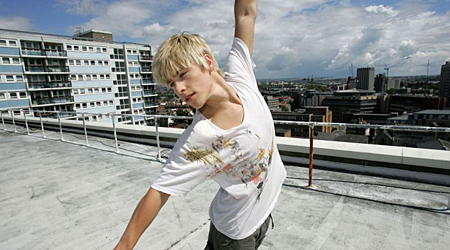
The homosexual stereotype is quite far reaching, to display this I will be looking at a prime example from the popular TV show Skins, Maxxie, dispalyed in a picture tap dancing below.

However let's first look at the stereotypes that comes with homosexuality.
Appearance
So if we then look to apply what has been discussed to Maxxie we can clearly see that he is the embodiment of an homosexual, he is everything that has been listed and if not more! If we just look at the opening scene of a Skins episode we have this enforced by having Maxxie tap dancing and talking about this "big gay night out".
If we then looked at my other work of homosexuals with Torchwood you can see they all have a clear link between them, it's very unlikely that if you look at a drama that you do not find some sexuality storyline in it. However it is clear that Maxxie is a prime example of what it means to be a stereotypical homosexual.
However let's first look at the stereotypes that comes with homosexuality.
Appearance
- Highlight hair
- Tight clothing
- Physically fit
- A wrist deficiency
- Very good posture
- Extremist of politeness as well as bitchiness'
- Prone to giggling like a pre-school girl
- Higher pitched voice
- Creative Arts - Dancing etc.
- Shopping
- Social Centre
- Hair Dresser
- Gossiping.
So if we then look to apply what has been discussed to Maxxie we can clearly see that he is the embodiment of an homosexual, he is everything that has been listed and if not more! If we just look at the opening scene of a Skins episode we have this enforced by having Maxxie tap dancing and talking about this "big gay night out".
If we then looked at my other work of homosexuals with Torchwood you can see they all have a clear link between them, it's very unlikely that if you look at a drama that you do not find some sexuality storyline in it. However it is clear that Maxxie is a prime example of what it means to be a stereotypical homosexual.
Wednesday, 11 February 2009
Compare the ways in which “This is England” and “Hot Fuzz” were packaged, marketed, distributed and exhibited in the UK.
When a film idea is born, a lot of things happen from producers being brought in to the location being picked, however no film can get off the ground without finance, the way new born films do this is to package all of the details they've got and wrap it up nicely. The items included within this nice wrapping is director, script, whether it's a best selling book, the production company, actors, music, location and of course the genre of the film.
When comparing the difference of packaging of both projects you can clearly see that Hot Fuzz has a huge budget compared to that of This is England from the actor prospective. Hot Fuzz has huge names from Simon Pegg and Nick Frost doing Shaun of the Dead and of course Timothy Dalton being the James Bond actor from The Living Daylights.
This is further enforced by the production companies behind each film, where as This is England has a small yet popular British company Warp Films and Film4 where as Hot Fuzz has Universal Pictures and Big Talk Productions showing it's huge budget as well as probability of being a good film by having Universal Pictures pump out many action films such as Bourne.
The marketing behind This is England was quite small when compared to the huge amount of advertisements done via Hot Fuzz, also due to the massive following of Shaun of the Dead it was quite far ahead. However This is England also had a large following straight off due to being done by director Shane Meadows, renowned for directing “Trainspotting”.
Distribution was a simple procedure for Hot Fuzz going from Cinema to Dvd to Tv where as This is England was quite different. For a start it wasn't setup to go world wide, it was expected to be quite small however due to word of mouth it was transported all over the place.
The exhibition was quite interesting, if we look first at This is England below you will find the Dvd analysed.
 Overall it is quite clear that Hot Fuzz had the larger budget behind it, however This is England also did extremely well.
| Item | This is England | Hot Fuzz |
| Director | Shane Meadows | Edgar Wright |
| Writers | Shane Meadows | Edgar Wright & Simon Pegg |
| Origin | N/A | N/A |
| Production Co. | Warp Films, Film4. | Big Talk Productions |
| Leading Actors | Thomas Turgoose | Simon Pegg, Nick Frost |
| Music | Let's Dance | Slippery Rock 70's |
| Location | Nottinghamshire and Lincolnshire - UK | Rural England - Somerset |
| Genre (sub) | Drama
| Action/Comedy & sub-genres of Crime/mystery |
| Release Data | 27 April 2007 | 14 February 2007 |
When comparing the difference of packaging of both projects you can clearly see that Hot Fuzz has a huge budget compared to that of This is England from the actor prospective. Hot Fuzz has huge names from Simon Pegg and Nick Frost doing Shaun of the Dead and of course Timothy Dalton being the James Bond actor from The Living Daylights.
This is further enforced by the production companies behind each film, where as This is England has a small yet popular British company Warp Films and Film4 where as Hot Fuzz has Universal Pictures and Big Talk Productions showing it's huge budget as well as probability of being a good film by having Universal Pictures pump out many action films such as Bourne.
The marketing behind This is England was quite small when compared to the huge amount of advertisements done via Hot Fuzz, also due to the massive following of Shaun of the Dead it was quite far ahead. However This is England also had a large following straight off due to being done by director Shane Meadows, renowned for directing “Trainspotting”.
Distribution was a simple procedure for Hot Fuzz going from Cinema to Dvd to Tv where as This is England was quite different. For a start it wasn't setup to go world wide, it was expected to be quite small however due to word of mouth it was transported all over the place.
The exhibition was quite interesting, if we look first at This is England below you will find the Dvd analysed.
 Overall it is quite clear that Hot Fuzz had the larger budget behind it, however This is England also did extremely well.
Monday, 9 February 2009
How is sexuality represented in Torchwood
Due to the main character within Torchwood, Captain Jack, being homosexual I will be concentrating on how stereotyping has been arranged around him and his relationship with Captain John is represented throughout the 5 minute clip, I will be doing this by looking at the micro and macro features thereby adding up to the representation.
Firstly let's look at how the characters are dressed, Jack is dressed in a military style long coat displaying a fierce and masculine appearance which goes completely against the stereotypical homosexual. This is further enforced by how John is dressed in flamboyant clothing representing the expected homosexual attire.
The entering of the bar itself enforces a more masculine feel by how the shots are displaying the characters as imposing with high angle shots and panning from the feet up to the body making them seem larger. This then adds up to a feeling of an upcoming clash of the captains, which is a reverse representation of the homosexuality due to be aggressive.
This aggression is also imposed upon the audience by the mise-en-scene of the surroundings, the bar itself being called Reunion makes you expect a meeting of old friends or enemies, however with the bar doors being western of origin and how we follow Captain Jacks boots to the bar the audience is then allowed to guess a fight is about to break lose.
The mise-en-scene of the bar itself however enforces the homosexual representation by the candle like lighting, adding a mysterious and sensual feel to the scene. With the plasma tv's also displaying a virtual fire it builds up to allow the audience to deduce that there is a natural attraction between the 2 captains. By the full on kiss and the mise-en-scene it all adds up to a stereotypical representation of homosexuals being sensitive and feminine.
However after the impressive kiss a large number of reverse stereotypes appear, firstly the fact that rather than going off to a room and doing “what comes naturally” the captains start to have a fight. This is most likely due to the airing of the show meaning it is unable to show 2 grown men making love to each other, so the director employs the next best thing for guys, a playful fight.
This fight in itself is a non-stereotype for homosexuals due to it's pure violence, however with the music of Song2, or Woo Hoo, in the background you feel that they're enjoying it, as though it's replacing the sex scene. This is further enforced by how both characters are grinning throughout the fight and seem oblivious to the damage they are doing to their surroundings.
After the majority of the fight the male characters are then seen via 180 degree rule shot while having them do a 360 staring at each other. However this is a contradicting shot by how a stereotypical aspect is shown with both characters commenting on their attire and staring each other in the eyes yet a reverse stereotype is also employed by how both captains are pointing lethal weapons at one another.
This is then followed with Jack and John then having a little chat against the bar. This in itself is a homosexual stereotype, due to most males at a bar simply drinking and rarely having a friendly chat. John also has a little giggle while covering his mouth with his hand displaying a common signifier for a homosexuals. Yet there is a clear reverse stereotype by how John drinks a huge amount of alcohol.
We then go into the conversation between the characters displaying a strong non-homosexual feeling by how both characters are sitting there leaning against the bar holding drink. The dialogue itself is extremely masculine by how John describes his rehabilitation for sex, drugs and murder as some sort of little joke. This is a strong reverse representation of homosexuals due to it's pure insensitivity.
If we look away from Jack and John and look at the gang in the taxi we get another stereotyping of homosexuals and how they're all liked by the group due to being mysterious and fun to have around. This represents the general expectations of homosexuals being at the centre of the group.
However the overall representation of sexuality in this clip is homosexual, and it displays them as a mixture of passionate love and boyish behaviour. There is little other sexuality's displayed apart from within the Taxi, and there is to little to analyse within that section.
Firstly let's look at how the characters are dressed, Jack is dressed in a military style long coat displaying a fierce and masculine appearance which goes completely against the stereotypical homosexual. This is further enforced by how John is dressed in flamboyant clothing representing the expected homosexual attire.
The entering of the bar itself enforces a more masculine feel by how the shots are displaying the characters as imposing with high angle shots and panning from the feet up to the body making them seem larger. This then adds up to a feeling of an upcoming clash of the captains, which is a reverse representation of the homosexuality due to be aggressive.
This aggression is also imposed upon the audience by the mise-en-scene of the surroundings, the bar itself being called Reunion makes you expect a meeting of old friends or enemies, however with the bar doors being western of origin and how we follow Captain Jacks boots to the bar the audience is then allowed to guess a fight is about to break lose.
The mise-en-scene of the bar itself however enforces the homosexual representation by the candle like lighting, adding a mysterious and sensual feel to the scene. With the plasma tv's also displaying a virtual fire it builds up to allow the audience to deduce that there is a natural attraction between the 2 captains. By the full on kiss and the mise-en-scene it all adds up to a stereotypical representation of homosexuals being sensitive and feminine.
However after the impressive kiss a large number of reverse stereotypes appear, firstly the fact that rather than going off to a room and doing “what comes naturally” the captains start to have a fight. This is most likely due to the airing of the show meaning it is unable to show 2 grown men making love to each other, so the director employs the next best thing for guys, a playful fight.
This fight in itself is a non-stereotype for homosexuals due to it's pure violence, however with the music of Song2, or Woo Hoo, in the background you feel that they're enjoying it, as though it's replacing the sex scene. This is further enforced by how both characters are grinning throughout the fight and seem oblivious to the damage they are doing to their surroundings.
After the majority of the fight the male characters are then seen via 180 degree rule shot while having them do a 360 staring at each other. However this is a contradicting shot by how a stereotypical aspect is shown with both characters commenting on their attire and staring each other in the eyes yet a reverse stereotype is also employed by how both captains are pointing lethal weapons at one another.
This is then followed with Jack and John then having a little chat against the bar. This in itself is a homosexual stereotype, due to most males at a bar simply drinking and rarely having a friendly chat. John also has a little giggle while covering his mouth with his hand displaying a common signifier for a homosexuals. Yet there is a clear reverse stereotype by how John drinks a huge amount of alcohol.
We then go into the conversation between the characters displaying a strong non-homosexual feeling by how both characters are sitting there leaning against the bar holding drink. The dialogue itself is extremely masculine by how John describes his rehabilitation for sex, drugs and murder as some sort of little joke. This is a strong reverse representation of homosexuals due to it's pure insensitivity.
If we look away from Jack and John and look at the gang in the taxi we get another stereotyping of homosexuals and how they're all liked by the group due to being mysterious and fun to have around. This represents the general expectations of homosexuals being at the centre of the group.
However the overall representation of sexuality in this clip is homosexual, and it displays them as a mixture of passionate love and boyish behaviour. There is little other sexuality's displayed apart from within the Taxi, and there is to little to analyse within that section.
Friday, 6 February 2009


Tuesday, 3 February 2009
How is sexuality represented in Torchwood [Draft]
Due to the main character within Torchwood, Captain Jack, being gay I will be concentrating on how stereotyping has been arranged around him and how his relationships are represented throughout the 5 minute clip. The first major non-stereotype of homosexuals is the way Jack is actually dressed in a long coat military style, rather than in a fancy costume similar to that of John's.
At the beginning of the clip you get a feel of western origin by how you follow Johns feet walking towards the bar and watch him enter through swinging half-doors, this connotes violence and cowboys, not pink clothes and giggling as related to most homosexuals, however an interesting quirk of Mise-en-scene is how the bar is named “Reunion”, which is just what happens with Jack and John knowing each other.
Throughout the following scene there is a large number of contradicting stereotypes from Manly to homosexual. We first have how the 2 male characters march up to each other like they mean business, where as they then have a passionate kiss in front of a Plasma TV fire, this in itself connotes a fiery passion of attraction to each other, however due to the airing of the show they can't show 2 men making love to each other so instead they then employ a boyish fight.
This fight in itself is a non-stereotype for homosexuals due to it's pure violence, however with the music of Song2, or Woo Hoo, in the background you feel that they're enjoy it, as though it's replacing the sex scene. This is further enforced by how both characters are grinning throughout the fight and seem oblivious to the damage they are doing to their surroundings. After the majority of the fight the male characters then comment on each others appearance in a very homosexual manner with John saying Jack has put on weight and John commenting on Jack losing his hair.
The following action of the Jack and John then having a little chat against the bar is also filled with stereotypes attacking each other for dominance, you first have a little giggle with John covering his mouth with his hand as a common signifier for a homosexual but then you have him drinking a huge amount of alcohol and in the same minute joking about murder, which is totally the opposite of each other.
If we look away from Jack and John and look at the gang in the taxi we get another stereotyping of homosexuals and how they're all liked by the group due to being mysterious and fun to have around.
However the overall representation of sexuality in this clip is homosexual, and it displays them as a mixture of passionate love and boyish behaviour. This is little other sexuality's displayed apart from within the Taxi, and there is to little to analyse within that section.
At the beginning of the clip you get a feel of western origin by how you follow Johns feet walking towards the bar and watch him enter through swinging half-doors, this connotes violence and cowboys, not pink clothes and giggling as related to most homosexuals, however an interesting quirk of Mise-en-scene is how the bar is named “Reunion”, which is just what happens with Jack and John knowing each other.
Throughout the following scene there is a large number of contradicting stereotypes from Manly to homosexual. We first have how the 2 male characters march up to each other like they mean business, where as they then have a passionate kiss in front of a Plasma TV fire, this in itself connotes a fiery passion of attraction to each other, however due to the airing of the show they can't show 2 men making love to each other so instead they then employ a boyish fight.
This fight in itself is a non-stereotype for homosexuals due to it's pure violence, however with the music of Song2, or Woo Hoo, in the background you feel that they're enjoy it, as though it's replacing the sex scene. This is further enforced by how both characters are grinning throughout the fight and seem oblivious to the damage they are doing to their surroundings. After the majority of the fight the male characters then comment on each others appearance in a very homosexual manner with John saying Jack has put on weight and John commenting on Jack losing his hair.
The following action of the Jack and John then having a little chat against the bar is also filled with stereotypes attacking each other for dominance, you first have a little giggle with John covering his mouth with his hand as a common signifier for a homosexual but then you have him drinking a huge amount of alcohol and in the same minute joking about murder, which is totally the opposite of each other.
If we look away from Jack and John and look at the gang in the taxi we get another stereotyping of homosexuals and how they're all liked by the group due to being mysterious and fun to have around.
However the overall representation of sexuality in this clip is homosexual, and it displays them as a mixture of passionate love and boyish behaviour. This is little other sexuality's displayed apart from within the Taxi, and there is to little to analyse within that section.
Tuesday, 20 January 2009
Comparing Holby City & Coronation Street Openings.
Comparing the Holby City & Coronation Street Openings is quite simple, below you will find both linked below to youtube for reference.
--------------------------------------------------------------------------------------------------
To compare Holby City and Coronation Street let's first look at Coronation Street in detail and then compare it to Holby City. Coronation Street, or Corrie, has quite a few unique features in it's opening however all connote a slow and steady storyline. The music is a slow beat traditional sounding music similar to the surroundings you are shown within the opening, an old city urban area where it's clear all the action is going to happen. The traditional, or old, feeling is further enforced by the condition of the area, it is clearly old as shown by the cobbled street and brick work looking very worn for wear.
There are very few camera angles used throughout the opening of Corrie due to how no characters are even displayed! You gain an Ariel shot of the area as well as some medium shots of the buildings with some zooming in however you never see a close up of a person or figure. The editing techniques are also rather bland with very little used apat from some fading affects between different shots. All of this points to a slow and steady drama, not faced pasted or adventurous.
Holby City on the other hand is another bottle of fish entirely! Where as the music in Coronation Street is slow beat Holby City is filled with a heart monitor beeping, connoting a Medical Drama along with tension filled music slowly getting faster throughout the opening. The music is further enforced by the adding of different instruments throughout the opening, far different to Coronation Street. This may point to the difference audiences envolved, and the different age groups due to the different pace of music, Corrie clearly is more interested in the steady drama lover where as Holby City would like the more active viewers.
The shot types and editing techniques further enforce this view, on how the picture is always busy with sometimes up to 2 different scenes in the same shot. This connotes a fast paced drama where you will be on the edge of your seat throughout! The editing techniques themselves are very impressive by the way the picture is layered multiple times, with the blue tinge of a background, a heart monitor display and finally the scene! Compared to Corrie this is a vast improvement.
The camera angles are far more numerous and shown throughout Holby City's opening with extreme close ups of the medical equipment and, what we can only assume, characters running quickly across the video. All of these close ups of medical equipment and running people add to the Mise En Scene of an image of a real medical institute! It's believable that it is actually a surgery.
Overall the differences between Holby City and Coronation Street is large, however this could be quickly explained by the different audiences that each drama which to engage. Coronation Street is obviously interested in the long time watcher, drawing the story out. Where as Holby City obviously wishes to engage those that want fast paced action where life or death are in the balance.
--------------------------------------------------------------------------------------------------
There are very few camera angles used throughout the opening of Corrie due to how no characters are even displayed! You gain an Ariel shot of the area as well as some medium shots of the buildings with some zooming in however you never see a close up of a person or figure. The editing techniques are also rather bland with very little used apat from some fading affects between different shots. All of this points to a slow and steady drama, not faced pasted or adventurous.
Holby City on the other hand is another bottle of fish entirely! Where as the music in Coronation Street is slow beat Holby City is filled with a heart monitor beeping, connoting a Medical Drama along with tension filled music slowly getting faster throughout the opening. The music is further enforced by the adding of different instruments throughout the opening, far different to Coronation Street. This may point to the difference audiences envolved, and the different age groups due to the different pace of music, Corrie clearly is more interested in the steady drama lover where as Holby City would like the more active viewers.
The shot types and editing techniques further enforce this view, on how the picture is always busy with sometimes up to 2 different scenes in the same shot. This connotes a fast paced drama where you will be on the edge of your seat throughout! The editing techniques themselves are very impressive by the way the picture is layered multiple times, with the blue tinge of a background, a heart monitor display and finally the scene! Compared to Corrie this is a vast improvement.
The camera angles are far more numerous and shown throughout Holby City's opening with extreme close ups of the medical equipment and, what we can only assume, characters running quickly across the video. All of these close ups of medical equipment and running people add to the Mise En Scene of an image of a real medical institute! It's believable that it is actually a surgery.
Overall the differences between Holby City and Coronation Street is large, however this could be quickly explained by the different audiences that each drama which to engage. Coronation Street is obviously interested in the long time watcher, drawing the story out. Where as Holby City obviously wishes to engage those that want fast paced action where life or death are in the balance.
Tuesday, 6 January 2009
Analysis of Max's Death
Below you will find the clip showing the death scene of Max, before we go onto the analysis let's first define the characters to better describe and understand what / who I will be describing throughout - This is a note for myself as well as anyone who has not watched Hollyoaks before.
-----------------------------------------------------------------------------------------
The beginning of the clip starts with Tom chasing after his Action Man toy with a mixture of diagetic sound of a car engine, a warning of what's to come, along with a common medical drama noise from the likes of ER of a heart monitor, as well as non-diagetic sound of an action scene from a movie such as James Bond which is to build up suspense. All of the sound points towards a larger issue about to appear.
With the quick succession of shots between all of the male characters, one Nile breathing heavily connoting anxiety and aggression along with OB and Max being seen behind bars as though entrapped with no way out within view of the shot all points towards a regrettable and unchangeable event. Furthermore when Max runs out in fear of the what is going to happen you hear at the same time as he shouts Tom the revving of the car engine all pointing towards a collision. At the same time this is when the non-diagetic music reaches it's climax of action just when Max pushes Tom out of the road. It then switches into a more slow and saddening song as soon as Max is hit by the car, portraying an extremely sad moment.

The tragedy of the event is further enforced by having a close up of Tom's action man figure landing on the ground with a large cracking noise as though breaking a bone face first and is in a similar position to Max lying next to the curb. Once again there is a quick succesion of shots including a slow motion medium shot of OB running to Max, a zooming in close up of Max which all point towards the seriousness of the situation hooking the audience in.
We then switch back to Nile with a birds eye view, which slowly rotates as his sight of vision does while also floating upwards with a medium shot of him crouch running towards Max in OB's arms, this all happens at a slower than normal speed furthermore digging in the extent of damage and seriousness of the situation.
However OB quickly takes hold of the situation in a male dominant way and tells Nile to call for an ambulance, you can tell he is talking to Nile due to the 180 degree rule between them. Nile is running towards the left of the screen where as Nile is looking towards the right. OB furthermore takes control by soothing Max telling him it's going to be "Fine" there is nothing wrong, and trying to completely ignore, if not joke off, the seriousness of the situation.

Max realises the seriousness of his injuries and like a true gentlemen would in all fairy tales does not complain and tries to convey his final words to his best friend about his feelings for his was-to-be-wife and OB. When finally Max states "Cold" we switch to a close up shot of Tom crying, adding a twist to the dagger already in your heart, due to the child being so upset by what he's seeing you can help but be tugged at your heart strings. OB's joking nature is shown more so by when Max states "I love you mate" OB trys to simply say "What? Listen don't be gay." and tries to keep Max alive by telling him don't leave me, and he finally states "What can I do without my best mate hey?" where you finally see the male gender facade of strenght crack, when it sinks in Max is dead.

We then have Nile simply say "Sorry" and run a slight distance away where he collapses and holds he head in his hands. A clear division between Nile and the 2 other adult males is the fact he is wearing a black leather jacket which when referencing to other dramas is normally linked to violence such as seen in East Enders. At this point we have Steph, the wife-to-be come onto the scene in her perfect feminine look, a white wedding dress, perfect hail nothing out of place of dirty.
This is where we see the stereotypical female who runs to the scene crying out "Max!!", at this point the non-diagetic changes into a church choir sort of noise, connoting Max rising up to heaven. After a few more statements of disbelief from Steph the voices are cut out completely and we only see the characters crying and mouthing their pain, we can all picture what they're saying and this also pulls at the audiences heart strings seeing all 3 characters, OB, Tom and Steph crying together around Max's dead body.

As you can see by the stillshot of the video Stephs wedding dress is laid out in a perfect semi-circle further pushing the thoughts of her being truly feminine, both genders have been shown as typically expected with the Male trying to cover it up in a joke where as the female has gone melodramatic. Max is also shown as innocent in this image with his head lying on Stephs lap, her white dress connotes his innocence. Also with the birds eye view slowly zooming out and slowly tilting towards the green tree and then fading out towards white it adds a feeling of rising up towards the sky, or heaven making the audience make a mental link of him going up to heaven.

Finally after the white fade out we come to a home made video shot of OB asking Max "What is love" which Max replies "Right now mate, the best thing in the world" which adds another pull towards the audiences heart strings due to us not knowing if that was 10minutes before his death or an hour. The scene then finally fades out to black showing us the end.
The clip takes advantage of a few stereotypical beliefs such as how genders act portraying OB, the male, as a strong character who doesn't crack until his friend is finally dead while also portraying the female as weak and vulnerable, even melodramatic, by shrieking about Max. However it also takes advantage of things that touch as all such as the true vulnerability of the child Tom which pulls at our heartstrings.
Overall the clip is an affect one which most likely does the desired affect of shocking and touching the audience at the same time.
- Max - One being hit by the car
- OB - Max's best friend (Hold's him)
- Nile - The one in the car hitting Max
- Steph - The female in the wedding dress
- Tom - The child
The beginning of the clip starts with Tom chasing after his Action Man toy with a mixture of diagetic sound of a car engine, a warning of what's to come, along with a common medical drama noise from the likes of ER of a heart monitor, as well as non-diagetic sound of an action scene from a movie such as James Bond which is to build up suspense. All of the sound points towards a larger issue about to appear.
With the quick succession of shots between all of the male characters, one Nile breathing heavily connoting anxiety and aggression along with OB and Max being seen behind bars as though entrapped with no way out within view of the shot all points towards a regrettable and unchangeable event. Furthermore when Max runs out in fear of the what is going to happen you hear at the same time as he shouts Tom the revving of the car engine all pointing towards a collision. At the same time this is when the non-diagetic music reaches it's climax of action just when Max pushes Tom out of the road. It then switches into a more slow and saddening song as soon as Max is hit by the car, portraying an extremely sad moment.

The tragedy of the event is further enforced by having a close up of Tom's action man figure landing on the ground with a large cracking noise as though breaking a bone face first and is in a similar position to Max lying next to the curb. Once again there is a quick succesion of shots including a slow motion medium shot of OB running to Max, a zooming in close up of Max which all point towards the seriousness of the situation hooking the audience in.
We then switch back to Nile with a birds eye view, which slowly rotates as his sight of vision does while also floating upwards with a medium shot of him crouch running towards Max in OB's arms, this all happens at a slower than normal speed furthermore digging in the extent of damage and seriousness of the situation.
However OB quickly takes hold of the situation in a male dominant way and tells Nile to call for an ambulance, you can tell he is talking to Nile due to the 180 degree rule between them. Nile is running towards the left of the screen where as Nile is looking towards the right. OB furthermore takes control by soothing Max telling him it's going to be "Fine" there is nothing wrong, and trying to completely ignore, if not joke off, the seriousness of the situation.

Max realises the seriousness of his injuries and like a true gentlemen would in all fairy tales does not complain and tries to convey his final words to his best friend about his feelings for his was-to-be-wife and OB. When finally Max states "Cold" we switch to a close up shot of Tom crying, adding a twist to the dagger already in your heart, due to the child being so upset by what he's seeing you can help but be tugged at your heart strings. OB's joking nature is shown more so by when Max states "I love you mate" OB trys to simply say "What? Listen don't be gay." and tries to keep Max alive by telling him don't leave me, and he finally states "What can I do without my best mate hey?" where you finally see the male gender facade of strenght crack, when it sinks in Max is dead.

We then have Nile simply say "Sorry" and run a slight distance away where he collapses and holds he head in his hands. A clear division between Nile and the 2 other adult males is the fact he is wearing a black leather jacket which when referencing to other dramas is normally linked to violence such as seen in East Enders. At this point we have Steph, the wife-to-be come onto the scene in her perfect feminine look, a white wedding dress, perfect hail nothing out of place of dirty.
This is where we see the stereotypical female who runs to the scene crying out "Max!!", at this point the non-diagetic changes into a church choir sort of noise, connoting Max rising up to heaven. After a few more statements of disbelief from Steph the voices are cut out completely and we only see the characters crying and mouthing their pain, we can all picture what they're saying and this also pulls at the audiences heart strings seeing all 3 characters, OB, Tom and Steph crying together around Max's dead body.

As you can see by the stillshot of the video Stephs wedding dress is laid out in a perfect semi-circle further pushing the thoughts of her being truly feminine, both genders have been shown as typically expected with the Male trying to cover it up in a joke where as the female has gone melodramatic. Max is also shown as innocent in this image with his head lying on Stephs lap, her white dress connotes his innocence. Also with the birds eye view slowly zooming out and slowly tilting towards the green tree and then fading out towards white it adds a feeling of rising up towards the sky, or heaven making the audience make a mental link of him going up to heaven.

Finally after the white fade out we come to a home made video shot of OB asking Max "What is love" which Max replies "Right now mate, the best thing in the world" which adds another pull towards the audiences heart strings due to us not knowing if that was 10minutes before his death or an hour. The scene then finally fades out to black showing us the end.
The clip takes advantage of a few stereotypical beliefs such as how genders act portraying OB, the male, as a strong character who doesn't crack until his friend is finally dead while also portraying the female as weak and vulnerable, even melodramatic, by shrieking about Max. However it also takes advantage of things that touch as all such as the true vulnerability of the child Tom which pulls at our heartstrings.
Overall the clip is an affect one which most likely does the desired affect of shocking and touching the audience at the same time.
Micro & Macro. What are they?
The simplest explanation is one that we used in class.

To put it simply Mirco is the snowflakes, those little things which make the picture where as Macro is the whole picture, it's how all the micro adds up and represents itself to the audience. We then normally apply the information we have gained by analysing both micro and macro to consider how the audience may react differently to these representations.
Micro
Micro includes such things as:
Macro
Macro as previously mentioned is the entire picture, how the lighting represents someone. For instance if someone is shown from a low angle shot this makes the character look bigger thereby making the character look threatening, the way the camera is applied is the micro where as how it represents the character is the macro!
Simple Micro is the individual aspects of the product and the Macro is the implications of the Micro.

To put it simply Mirco is the snowflakes, those little things which make the picture where as Macro is the whole picture, it's how all the micro adds up and represents itself to the audience. We then normally apply the information we have gained by analysing both micro and macro to consider how the audience may react differently to these representations.
Micro
Micro includes such things as:
- Camera angles
- Shot types
- Composition
- Camera movement
- Editing Techniques
- Transition
- Sound
- Mise-en-scene
- Lighting
Macro
Macro as previously mentioned is the entire picture, how the lighting represents someone. For instance if someone is shown from a low angle shot this makes the character look bigger thereby making the character look threatening, the way the camera is applied is the micro where as how it represents the character is the macro!
Simple Micro is the individual aspects of the product and the Macro is the implications of the Micro.
Subscribe to:
Posts (Atom)
